


Kensington Palace sits on the western edge of Kensington Gardens and offers a quieter, more personal look at royal history than Buckingham Palace.
This is not the place to see balcony moments or changing of the guard. Instead, Kensington Palace focuses on how royals lived, the spaces they moved through, and the people who shaped British history behind palace doors.
I visited Kensington Palace as part of a slower London day, pairing the palace with time in Kensington Gardens rather than treating it as a full-day attraction.
Is Kensington Palace worth visiting?
YES, if your expectations are aligned.

Kensington Palace is worth visiting if you want:
- A calmer alternative to Buckingham Palace
- Insight into royal private life rather than pageantry
- Exhibitions that focus on people, fashion, and personal stories
- A visit that pairs well with parks, walking, and nearby museums
When I visited, the smaller scale made it easier to move at my own pace, especially compared with larger royal sites that can feel more structured and time-restricted.
It may not be the best fit if you’re short on time and only want:
- Iconic photo moments
- Grand halls on the scale of Versailles
- A fast, checklist-style attraction
What makes Kensington Palace different is scale and focus. The palace is smaller, but more detailed. Instead of overwhelming you with size, it invites you to slow down and understand how royal life actually worked.
If you’re visiting London for the first time and want a single royal experience, Buckingham Palace often makes more sense. If you’ve already done that — or want something less crowded and more reflective — Kensington Palace is a solid choice.
🏰 Kensington Palace at a glance
👍🏼 Best for: Visitors who enjoy royal history, art, jewellery, and quieter palace experiences
⏰ Time needed: 2–4 hours, including gardens
❗️Don’t miss: Throne Room, Cupola Room, Jewel Room, Sunken Garden
👩🏻🦽➡️Accessibility: Wheelchair-friendly with lifts, step-free routes, and free wheelchair loans
⭐️ Good to know: Gardens are free to enter, palace interiors require a ticket. If you’d prefer to skip ticket queues or visit with expert context, you can book skip-the-line Kensington Palace tickets or guided tours here.
What you actually see inside Kensington Palace?

What makes Kensington Palace distinctive is that it has functioned as a royal home for more than 300 years, not simply as a ceremonial showpiece. The palace evolved around the needs of the people who lived there — monarchs, consorts, children, and courtiers — and that lived-in quality still shapes the visit today.
Rather than overwhelming you with scale, Kensington Palace focuses on rooms with purpose, where power, identity, and private life intersect.
The Throne Room

The Throne Room is one of the most visually commanding spaces in the palace. This was where authority was made visible.
Rich decorative detail, formal symmetry, and prominent royal portraits reinforce hierarchy and status. Every element was designed to signal power, reminding visitors that this room once played a role in how monarchy was presented and understood.
It sets the tone for the palace experience, making clear that Kensington was a place where image and influence mattered deeply.
The Cupola Room
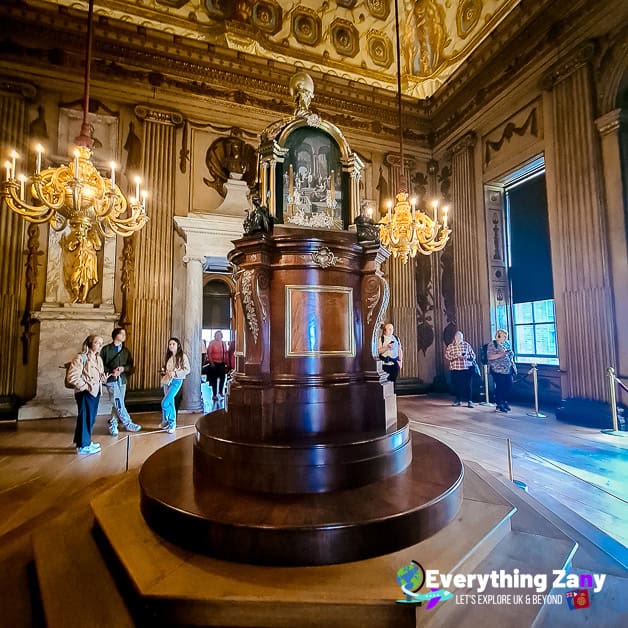
The Cupola Room offers a striking contrast. Known for its elegant ceiling and historic musical clock, it also carries strong personal significance.
This is where Queen Victoria was christened, linking the space directly to the beginnings of one of Britain’s most influential reigns. The room bridges public tradition and private life, a theme that runs throughout the palace.
Standing here, royal history feels personal rather than distant.
The King’s State Apartments
The King’s State Apartments were designed for public-facing royal life. These rooms were used for receptions, audiences, and the carefully managed movement of courtiers and visitors.

As you move through them, you’ll notice:
- Formal portraits asserting lineage and authority
- Sculpted busts and statues drawing on classical ideals of power
- Decorative schemes intended to impress and control how space was experienced

These rooms weren’t just decorative. They were tools of the monarchy, shaping perception and reinforcing order. The famous King’s Gallery is one of the iconic room in this area of Kensington Palace due to its grand display of various artworks and portraits.
The Queen’s State Apartments and the Drawing Room

The atmosphere shifts noticeably in the Queen’s State Apartments. These rooms feel more intimate, reflecting domestic life rather than public display.

The Drawing Room, closely associated with Queen Victoria, stands out in particular. Its scale, colour, and layered decoration give it a warmer, more personal feel. This was a space for conversation, reflection, and private social life.
It reinforces Kensington Palace’s role as a family residence, not just a formal court.
The Jewel Room and Royal collections
One of the most memorable parts of the visit is the Jewel Room, where royal jewellery is presented as personal history rather than decoration alone.


Here, jewellery is explored as:
- A symbol of inheritance and transition
- A marker of identity and status
- An expression of personal relationships within the monarchy

A highlight is the emerald jewellery set belonging to the young Queen Victoria, commissioned by Prince Albert. Seeing these pieces in person adds emotional depth to her story, especially when viewed alongside objects from her early life.


Nearby displays often include:
- Tiaras and formal jewellery worn at key moments
- Personal accessories that humanise royal figures
- Objects connected to royal childhood, including Victoria’s doll’s house

Together, these rooms and collections reveal royal life through objects, spaces, and lived experience, rather than spectacle.
The Gardens and Grounds
The gardens complete the story of Kensington Palace as a lived-in royal residence rather than a distant monument.

Set within Kensington Gardens, the palace was once surrounded by private royal grounds designed for walking, reflection, and retreat from public life. Today, most of these gardens are open to everyone, and they remain one of the strongest reasons to include Kensington Palace in a London itinerary.

Highlights include:
- The Sunken Garden, closely associated with Diana, Princess of Wales
- Formal paths and landscaped views shaped by royal use
- Open green spaces that connect naturally with Hyde Park
- The Orangery, originally built for Queen Anne as a space for entertaining, dining, and displaying citrus trees

The Orangery adds another layer to the experience. While no longer functioning as a traditional orangery, it reflects the palace’s role as a social and domestic space rather than a purely ceremonial one. Its position overlooking the gardens reinforces how closely royal life here was tied to the surrounding landscape.
The gardens help explain why Kensington Palace worked so well as a home. They offered privacy and calm while remaining close to the centre of London.
Visiting the gardens alongside the palace adds important context. It becomes easier to imagine daily royal life here — walking, pausing, entertaining guests, and stepping away from public ceremony.
Many visitors spend as much time outdoors as they do inside. Even without entering the palace, the gardens and Orangery alone make this area worth visiting.
How long to allow for a visit
Most visitors spend 1.5 to 2 hours inside Kensington Palace.
That’s enough time to:
- Walk through the State Apartments at a steady pace
- Read the exhibition displays without rushing
- Spend time in the Jewel Room and key historic rooms
If you enjoy reading labels and focusing on details like jewellery, portraits, and decorative objects, allow closer to two hours.
I found that trying to rush through the palace in under an hour takes away from what makes it special. The rooms are not overwhelming in number, but they reward slower attention.
Suggested time breakdown
- Palace interiors: 90 minutes to 2 hours
- Gardens and Orangery: 45 minutes to 1 hour
- Combined visit: Half a day, especially if paired with a walk through Kensington Gardens or Hyde Park
This makes Kensington Palace easy to fit into a wider London itinerary without dominating your day.
Tickets, exhibitions, and guided tours

Tickets are required to access the palace interiors, while the gardens remain free to enter.
A standard ticket includes:
- Access to the State Apartments
- Entry to permanent and temporary exhibitions
- Access to the Jewel Room and themed galleries
Exhibitions change regularly, which is worth keeping in mind if you’ve visited before. The focus often shifts between royal life, fashion, and personal stories rather than political history.
Are guided tours worth it?
Guided tours run on selected days and suit visitors who want deeper historical context and structured storytelling.
If you prefer moving at your own pace or spending more time in specific rooms, such as the jewellery displays, a self-guided visit works well. The written interpretation throughout the palace is clear and easy to follow.
Guided tours and skip-the-line tickets are available online. I usually recommend booking in advance during busy periods to secure your preferred time slot.
👉 You can check current availability and prices here.
On-site café and shop
Kensington Palace has a café and gift shop located within the palace grounds.
The café is a convenient stop before or after your visit, especially if you’re combining the palace with time in Kensington Gardens. It’s more practical than destination dining, but useful for a coffee or light bite without leaving the area.
The shop focuses on:
- Jewellery-inspired pieces
- Books and prints related to royal history
- Well-designed souvenirs that feel aligned with the palace rather than generic
If you enjoy browsing museum shops, it’s worth allowing a few extra minutes at the end of your visit.
Practical tips
- Booking tickets in advance is advisable during peak seasons
- Early entry tends to be quieter
- The palace is fully accessible, with lifts available for historic spaces
Accessibility at Kensington Palace
Kensington Palace is one of the more accessibility-friendly royal attractions in London, and it’s worth highlighting this clearly.
The palace is wheelchair accessible, with lifts and step-free routes connecting the main exhibition spaces. While this is a historic building, the layout has been thoughtfully adapted so visitors can still experience the full visit.
When I visited with my mum, who uses a wheelchair, the experience was genuinely smooth. The palace lent us a wheelchair free of charge, and staff were proactive and supportive throughout the visit.
They:
- Explained which routes were best for wheelchair users
- Used lifts and alternative pathways to avoid stairs
- Guided us between rooms so we didn’t miss key spaces
- Took the time to check we were comfortable before moving on
There are also shorter, accessible routes through the palace for visitors who need to manage energy levels without skipping major rooms.
Accessible toilets are available on site, and seating is provided in several gallery areas. The café and shop are also wheelchair accessible.
For a historic royal residence, the level of consideration and staff support stands out. It made the visit feel inclusive rather than restricted, which isn’t always the case with older landmarks.
If accessibility is a key factor in planning your visit, Kensington Palace is a confident and well-supported choice.
How to combine Kensington Palace with nearby attractions
One of Kensington Palace’s biggest advantages is its location. It sits within walking distance of several major London sights, making it easy to build a relaxed, well-paced day without constant transport changes.
Kensington Gardens and Hyde Park
Kensington Palace flows directly into Kensington Gardens, which then links seamlessly with Hyde Park.
This is the simplest and most natural pairing.
A typical plan works well like this:
- Visit the palace interiors first
- Spend time in the gardens and the Orangery
- Continue walking into Hyde Park for a slower afternoon
This option suits visitors who want:
- Open space after indoor sightseeing
- A flexible pace
- Somewhere to sit, walk, or pause without crowds
Victoria and Albert Museum

The Victoria and Albert Museum is around a 15-minute walk from Kensington Palace and pairs especially well if you enjoyed the palace’s jewellery, fashion, and decorative arts.
This combination works well if you’re interested in:
- Fashion history and design
- Decorative objects and craftsmanship
- Seeing royal style placed within a wider cultural context
Because the museum is large, it’s best to focus on one or two galleries rather than attempting a full visit on the same day.
Natural History Museum

The Natural History Museum is another easy walk and a good option if you’re travelling with family or want a change of pace after royal history.
It works best if:
- You’re visiting with children
- You want a visually impressive building
- You prefer interactive exhibits
This pairing makes for a full but manageable day, especially if you allow time for breaks between sites.
Science Museum

Shadowssettle, CC BY-SA 4.0, via Wikimedia Commons
For a more hands-on experience, the Science Museum is nearby and easy to slot in.
This works well if:
- You’re travelling with mixed interests
- Someone in your group prefers interactive exhibits
- You want something lighter after a history-heavy morning
Suggested half-day and full-day ideas
Half-day option
- Kensington Palace interiors
- Gardens and Orangery
- Short walk through Kensington Gardens
Full-day option
- Kensington Palace in the morning
- Lunch or coffee on site or nearby
- Afternoon at Hyde Park or one South Kensington museum
This flexibility is one of Kensington Palace’s strengths. You can shape the day around your energy level, interests, and accessibility needs without feeling rushed.
Where to Stay Near Kensington Palace
If you’d like to stay within walking distance of Kensington Palace, this part of London is one of the most convenient and well-connected areas to base yourself.
Kensington and South Kensington offer a balance of green space, museums, and easy transport links, while still feeling calmer than more central districts.
Best Area: South Kensington
South Kensington is ideal if you want to combine royal history with museum visits.
It offers:
- Walking distance to Kensington Palace
- Easy access to the Victoria and Albert Museum, Natural History Museum, and Science Museum
- Strong Tube connections via South Kensington station
This area suits:
- First-time visitors
- Culture-focused itineraries
- Families who want attractions within walking distance
Accommodation here ranges from boutique hotels to serviced apartments, which can work well for longer stays.
Best Area: Kensington and Hyde Park
If you prefer greener surroundings and a slightly quieter atmosphere, look towards Kensington or along Hyde Park.
This area offers:
- Immediate access to Kensington Gardens and Hyde Park
- A more residential feel
- Good access to High Street Kensington station
It works well if:
- You enjoy morning park walks
- You want space without leaving central London
- You prefer a slower pace at the end of the day
Hotels here often feel more relaxed compared to busier areas like Covent Garden or Soho.
Explore Available Hotels Near Kensington Palace
You can explore live prices and availability for hotels and apartments near Kensington Palace below.
Prices and availability update in real time, which makes it easier to compare options before finalising your stay.
HOW TO USE THIS MAP TO BOOK YOUR RESERVATIONS:
CLICK the YELLOW MARKER OR THE DROP DOWN MENU next to the title to see the various things to do and point of interest in this guide and CHOOSE your desired preview of the map, whether HOTELS & RENTALS, EXPERIENCES, RESTAURANTS OR OTHERS. Feel free to use the filters, number of guests, and your preferred dates. You can see more information about the different attractions (the GREEN MARKERS) when you click the icons, as well as finding your perfect accommodation that will suit your budget and location. You could also book your guided tours and restaurants using the map.
Quick planning tips and FAQs
Is Kensington Palace suitable for first-time visitors to London?
Yes, especially if you want a royal experience that feels calmer and more personal than Buckingham Palace. Kensington Palace works well as a first royal visit if you prefer exhibitions, storytelling, and historic interiors over ceremony.
If your trip is short and you only plan to visit one palace, Buckingham Palace may feel more iconic. If you have more time or want something less crowded, Kensington Palace is a strong choice.
Do I need to book tickets in advance?
Booking in advance is recommended, particularly during weekends, school holidays, and peak tourist seasons.
Advance booking helps you:
- Secure your preferred time slot
- Avoid queues at the entrance
- Plan your day more confidently
Walk-up tickets may be available, but availability isn’t guaranteed.
👉 You can check current availability and prices here.
How busy does Kensington Palace get?
Kensington Palace is generally quieter than Buckingham Palace, but it can still get busy.
The best times to visit are:
- Early mornings
- Weekdays outside school holidays
Midday and weekends tend to be livelier, especially in the Jewel Room and popular historic spaces.
Is Kensington Palace good for visitors with mobility needs?
Yes. Kensington Palace is one of the more accessibility-friendly historic attractions in London.
The palace offers:
- Step-free access and lifts between floors
- Wheelchairs are available to borrow free of charge
- Alternative routes that allow visitors to see the main rooms
- Helpful staff who guide visitors through accessible pathways
Accessible toilets, seating areas, and step-free access to the café and shop are also available.
Can you visit the gardens without a ticket?
Yes. Kensington Gardens are free to enter, and you don’t need a palace ticket to enjoy them.
This makes the area worth visiting even if you decide not to go inside the palace. The Sunken Garden and surrounding paths are popular stops on their own.
Is there food and shopping on site?
Yes. Kensington Palace has:
- A café for coffee, light meals, and breaks between sightseeing
- A well-curated shop selling books, jewellery-inspired items, and palace-themed gifts
Both are conveniently located and accessible, making them easy to include before or after your visit.
Is Kensington Palace worth it overall?
Kensington Palace is worth visiting if you enjoy:
- Royal history told through rooms and objects
- Art, jewellery, and personal stories
- A slower-paced, reflective palace experience
It may not suit visitors looking for large-scale spectacle or fast sightseeing. What it offers instead is depth, context, and a sense of how royal life was actually lived.
🏰🏰🏰
Kensington Palace stands out as a royal residence that feels human. Through its rooms, collections, and gardens, it offers insight into power, private life, and personal history rather than ceremony alone.
If you’re building a London itinerary that balances culture, walking, and space to slow down, Kensington Palace fits naturally — and rewards visitors who take their time.
If Kensington Palace is on your London itinerary, booking tickets in advance here can make the visit smoother, especially during peak seasons.

ABOUT THE AUTHOR

Ryazan Tristram
Travel Writer & Photographer
Ryazan has a Bachelor’s Degree in Tourism and Hotel Management. She also has more than 10 years of work experience gained from working in the hotel and travel sectors in Asia and Europe. Her work has been featured and published in BBC, Huffington Post, Reader’s Digest, Discovery Channel, World Travel Guide, MSN, CNBC, GMA, Daily Mail UK, Lonely Planet, and many more. She is currently living in the UK as a dual citizen (British-Filipina). Join her in travelling around the UK, Europe, and beyond with a mission to promote sustainable tourism and share travel guides, travel tips, foodies, history, and culture.